
AI Governance & Lifecycle Management
Accelerating AI Innovation. Operationalizing Governance.
Managing Risk Across the AI Lifecycle.
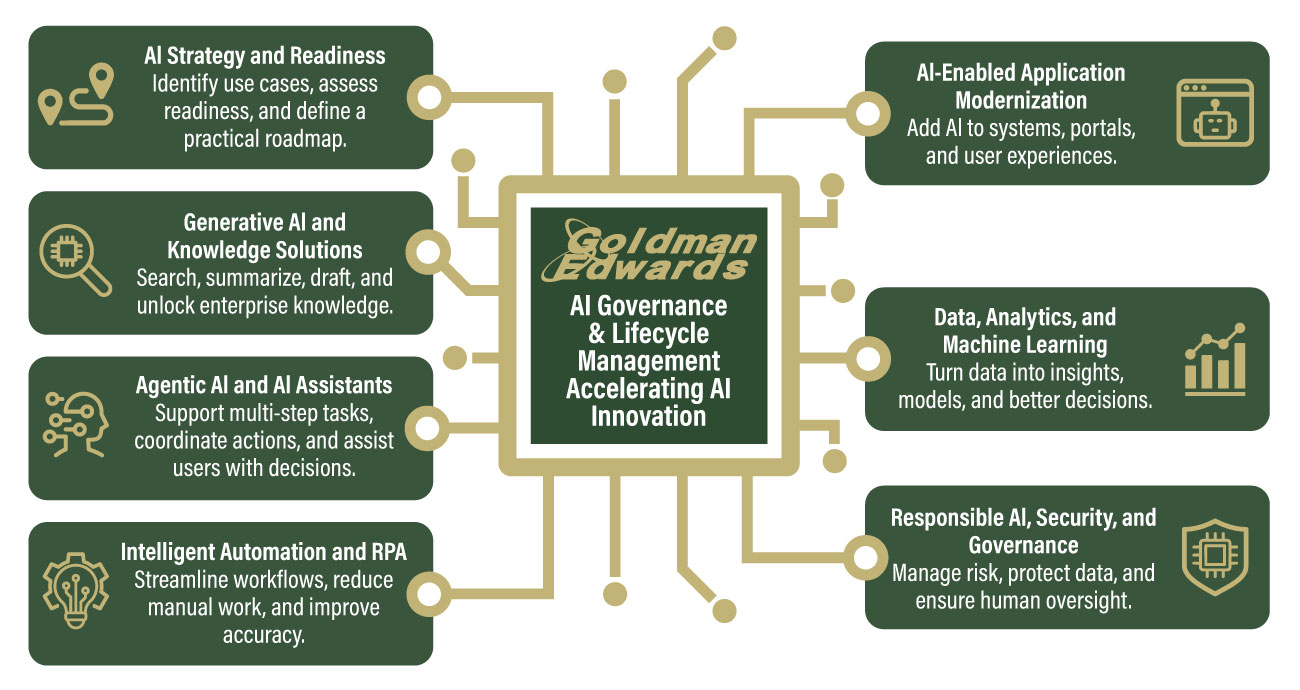
Goldman Edwards (GE) helps federal agencies move artificial intelligence from experimentation to secure, accountable, mission-ready deployment through an integrated AI Governance Lifecycle.
Our approach embeds governance, risk management, security, privacy, transparency, and human oversight throughout the AI lifecycle—enabling agencies to accelerate AI adoption while maintaining the controls required to protect government missions, data, systems, and the public.
From AI Policy to Operational Governance
Federal agencies are being asked not simply to adopt AI, but to establish the governance structures necessary to manage it responsibly at scale. GE transforms these requirements into an operational AI governance model that connects executive oversight with technology delivery.
Aligned to Federal AI Mandates
The GE AI Governance Lifecycle is designed to operationalize the federal government’s evolving AI requirements and leading risk-management frameworks.
OMB M-25-21 — Accelerating Federal Use of AI through Innovation, Governance, and Public Trust
GE’s lifecycle directly supports agency requirements involving Chief AI Officer governance, AI Governance Boards, AI strategies, compliance planning, AI policies, AI use-case inventories, high-impact AI risk management, and ongoing oversight.
OMB M-25-22 — Driving Efficient Acquisition of Artificial Intelligence in Government
GE integrates governance into the acquisition lifecycle to help agencies evaluate AI capabilities, establish appropriate requirements and safeguards, manage vendor and data risks, promote interoperability, and reduce unnecessary vendor lock-in.
NIST AI Risk Management Framework (AI RMF)
Our lifecycle operationalizes NIST’s four core AI risk-management functions:
GOVERN → MAP → MEASURE → MANAGE
Rather than treating these functions as a compliance exercise, GE embeds them throughout AI planning, development, deployment, monitoring, and retirement.
NIST Generative AI Profile
For Generative AI and Large Language Model solutions, GE extends governance into GenAI-specific risks, including model reliability, information
Our AI Governance Lifecycle supports:
- AI Strategy & Governance Frameworks — Establish governance charters, policies, decision rights, roles, oversight bodies, and operating procedures.
- AI Use-Case Intake & Inventory — Identify, document, prioritize, and maintain an enterprise inventory of AI systems and proposed use cases.
- AI Risk Classification & Assessment — Evaluate mission impact, data sensitivity, cybersecurity, privacy, model risk, human impact, and other risk factors.
- Governance Review & Approval — Establish repeatable review processes, decision gates, documentation requirements, and accountable risk acceptance.
- Responsible AI Development — Integrate governance requirements directly into Agile, DevSecOps, data, cloud, and AI development processes.
AI Testing, Evaluation, Verification & Validation (TEVV) — Evaluate accuracy, reliability, security, bias, explainability, robustness, and mission performance before deployment. - Deployment & Authorization Support — Align AI implementation with existing cybersecurity, privacy, IT authorization, and enterprise architecture processes.
- Continuous AI Monitoring — Monitor model performance, emerging risks, system changes, security, data quality, and operational effectiveness.
- Auditability & Compliance Evidence — Maintain traceability from the original AI use case through risk decisions, testing, approvals, deployment, and ongoing monitoring.
- AI Retirement & Lifecycle Management — Establish controls for modification, replacement, suspension, and retirement of AI capabilities.